Las Vegas Time Zone: How DST Changes Sunrise and Sunset Clock Times
See how PST, PDT and the 2026 daylight saving transitions affect the sunrise and sunset clock times shown for Las Vegas.
- Time Zones
- Daylight Saving Time
On this page
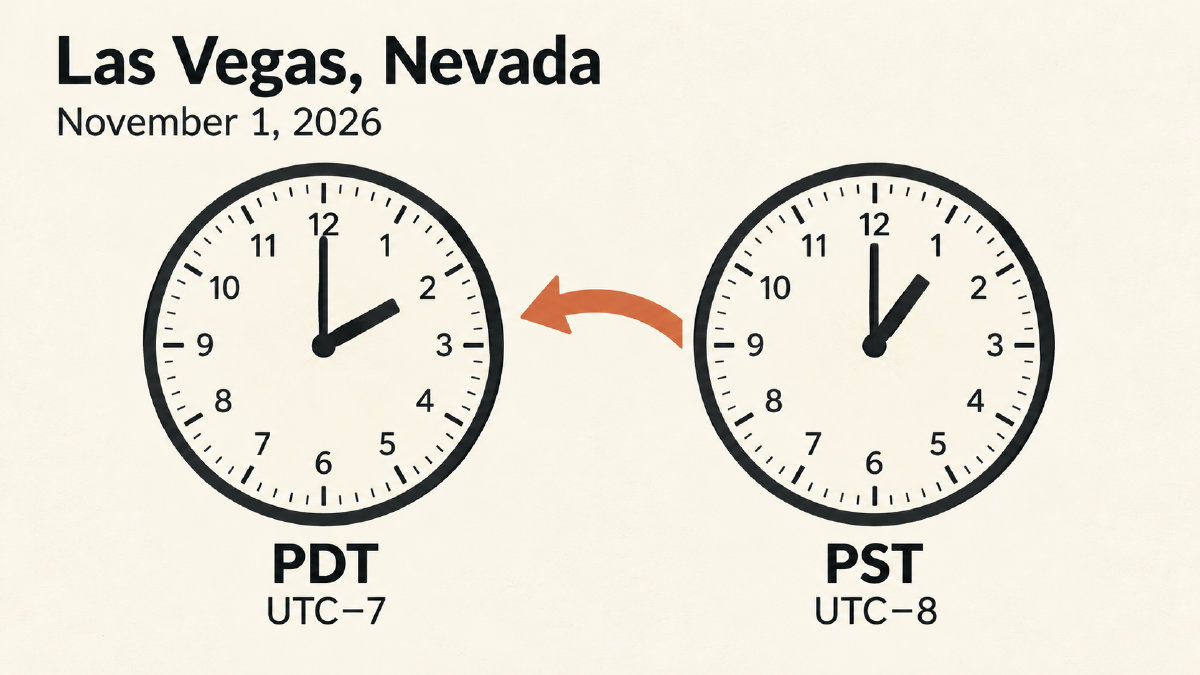
Las Vegas uses Pacific Time. It observes Pacific Standard Time (PST, UTC−8) in winter and Pacific Daylight Time (PDT, UTC−7) during daylight saving time. In 2026, clocks move from 2 a.m. PST to 3 a.m. PDT on March 8 and from 2 a.m. PDT back to 1 a.m. PST on November 1. The spring change skips an hour; the autumn change repeats one. These changes affect the local clock labels on Sunset Today, not the physical timing of the Sun.
Selecting a Date and Viewing Local Time
Sunset Today displays Las Vegas sunrise and sunset in the city’s local time. Next to the selected date, the page shows America/Los_Angeles and the applicable GMT offset (GMT−8 or GMT−7). When you first open the Las Vegas city page without a date parameter, it uses the current local date in Las Vegas; the address bar has no date parameter yet. To choose another day, use the “Date in Las Vegas” field near the top. After you select a day, the address bar stores it as ?date=YYYY-MM-DD, so the same view can be reopened. The selected Las Vegas date governs the result, even if your own device is in a different time zone. The calculation uses a representative point near the city center at latitude 36.175 and longitude −115.137, so observed times elsewhere in the metro area can differ slightly.
Sunset Today currently covers six U.S. cities: San Diego, San Francisco, New York, Chicago, Las Vegas, and Portland, Oregon. Each city page applies its own time zone to the selected date, so compare the printed local clock times and offsets rather than adding a manual conversion. The dates and Sun times are for each page’s representative city-center point.
Comparing Sunrise and Sunset Across a Clock Change
To compare days around the clock change, read the monthly calendar row by row. Each date is calculated with its own local time-zone offset. A November calendar can therefore cross from GMT−7 to GMT−8 without using one fixed offset for the whole month. The clock shift changes the displayed civil time by an hour; sunrise and sunset in solar terms, and the daylight duration between them, change gradually through the season. Daylight is the elapsed time between the sunrise and sunset shown for the same selected local date.
For a concrete example, select October 24, 2026 on the Las Vegas city page.
For October 24, 2026, the page shows sunrise at 06:56 and sunset at 17:54, both in PDT (GMT−7), with 10 hr 58 min of daylight. Select October 31 and then November 2 to compare dates on either side of the November 1 clock change. November 2 displays PST (GMT−8). The clock moves back an hour, while the actual daylight duration changes gradually; do not read a one-hour clock adjustment as a one-hour loss of sunlight.
Use the date and offset together whenever you compare morning or evening times across daylight saving time. The local horizon, weather and your exact position may make the observed event differ from the city-center calculation; Sunset Today is a planning reference rather than an exact on-site observation.