Pacific Time to Eastern Standard Time for Sunrise and Sunset
Convert Pacific Time to Eastern Standard Time for sunrise and sunset: when to add two or three hours, and how New York time differs.
- Time Zones
- Daylight Saving Time
On this page
The time zone of the destination determines whether you must add or subtract a specific number of hours. However, if the sunrise/sunset data is given in Pacific Standard Time (PST), then you need to add 3 hours to convert it to Eastern Standard Time (EST). Likewise, if it’s in Pacific Daylight Time (PDT), add 2 hours to convert it to EST. Pacific Time can mean the region’s current local time, whether PST or PDT. New York City is in the Eastern time zone and uses EST or EDT depending on the season. Fixed EST stays at UTC−5 all year, so it won’t always match New York’s clock.
When the sunrise/sunset time is listed as UTC−8, it is Pacific Standard Time. When it’s UTC−7, that is Pacific Daylight Time. The conversion will depend on when the event happens relative to the beginning or end of daylight saving time.
UTC−8 → UTC−5: PST to EST
UTC−7 → UTC−5: PDT to EST
UTC−8 → UTC−4: PST to EDT
UTC−7 → UTC−4: PDT to EDT
UTC−8 to UTC−5 adds three hours; UTC−7 to UTC−5 adds two hours. UTC−8 to UTC−4 adds four hours; UTC−7 to UTC−4 adds three hours.
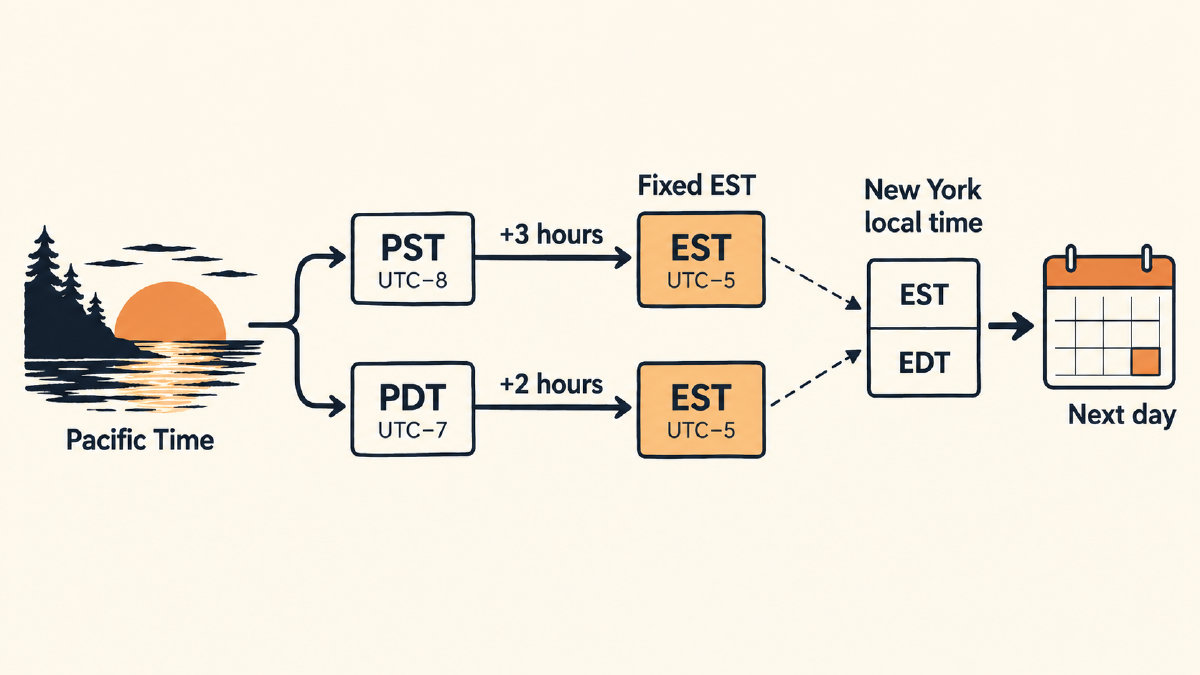
For instance, a sunrise at 6 a.m. PST would be at 9 a.m. EST. Similarly, a sunrise at 6 a.m. PDT would be at 8 a.m. EST. In this case, you are adding 3 or 2 hours respectively. A sunrise at 10 p.m. PST would be at 1 a.m. EST the next day. And a sunrise at 10 p.m. PDT would be at midnight EST or at 1 a.m. EDT the next day.
To apply the above conversions, simply find the location of interest within the U.S., then look up its local sunrise and sunset times. For instance, San Diego’s sunrise on October 26, 2026, is 7:02 a.m. PDT (UTC−7). Add 2 hours for 9:02 a.m. fixed EST, or 3 hours for 10:02 a.m. New York local time, EDT (UTC−4). The converted calendar date is still October 26.
San Diego, California
Local sunrise and sunset listings
Date selection
San Francisco, California
Local sunrise and sunset listings
Date selection
Las Vegas, Nevada
Local sunrise and sunset listings
Date selection
Portland, Oregon
Local sunrise and sunset listings
Date selection
Selected event
City, Local Date, Local Time, Applicable Pacific Offset
Destination
Fixed EST or New York local time at the same instant
Converted Calendar Date
New York, New York
Separate local sunrise and sunset listings
Date selection
Sunrise and sunset times vary depending on latitude. Within a time zone, your clock time may not match another city in that time zone exactly, but you can use the following examples as guidance:
If you choose to express that event on another clock, such as converting from San Diego, California, to fixed-time EST, then you have preserved both the location and the original local date. If you want to know what the sunrise or sunset was like in New York, you would need to separately look up the information for New York itself. Both examples involve using a different clock, so both involve some form of conversion. But there’s also a third possibility: you might just want to know the sunrise and sunset times in New York. To do that, you’d go to New York’s own website and select a local date and a local time. You wouldn’t even need to convert anything because you’re already interested in New York. So why convert?
In other words, sometimes people don’t think about it. But there are good reasons for doing so. It turns out that DST has been controversial, with many people complaining about the extra hour, which could help reduce crime and traffic accidents, according to some studies.
Daylight Saving Time Transitions
DST starts on the second Sunday in March at 2 a.m. local time, where the clocks spring forward by one hour, skipping an hour. DST ends on the first Sunday in November at 2 a.m. local time, where the clocks fall back by one hour, thereby repeating an hour. Because each time zone changes at its own local time, these dates aren’t simultaneous across the country. Some cities might change their clocks earlier than others, so these dates represent different instants. For example, in the fall, Eastern clocks return to standard time before Pacific clocks do, briefly leaving PDT and EST 2 hours apart. This happens in November, after the autumnal equinox.
On these days, the difference between the two time zones is only temporary. On the spring gap, when we switch from standard time to daylight saving time, the time difference becomes temporary too.
On those dates, it is important to identify the event precisely — the date, the local time, and an explicit UTC offset or seasonal abbreviation. Otherwise, someone else may misinterpret the exact moment that occurred.
Because some regions change their clocks at different times than others, the difference between Pacific and Eastern clocks can change briefly during transitions. During the spring transition, Eastern clocks are temporarily 4 hours ahead of Pacific clocks instead of 3, while in the fall, they are temporarily 2 hours ahead instead of 3. This applies only to those locations that change clocks during the transition period.
Nov 1, 2026–Mar 14, 2027: Standard-Time Season
Sources
Check sunrise and sunset times
Choose a city and date for local times and a monthly calendar.