How to Read CST Central Standard Time in Chicago’s Sun Calendar
Understand CST Central Standard Time, when Chicago uses CDT, and how to read sunrise and sunset calendar times without adjusting for DST twice.
- Time Zones
- Daylight Saving Time
On this page
Chicago is not only a place but also a reference point, where the CST Central Standard Time zone applies. The time zones around the globe are defined by their offset from Coordinated Universal Time (UTC), an atomic-clock-based time standard.
Central Standard Time and Central Time
There’s no one-size-fits-all way for defining a given location or city within that framework, however. For example, both “Central Standard Time” and “Central Time” apply to the same general geographic area, yet they have slightly different definitions. Specifically:
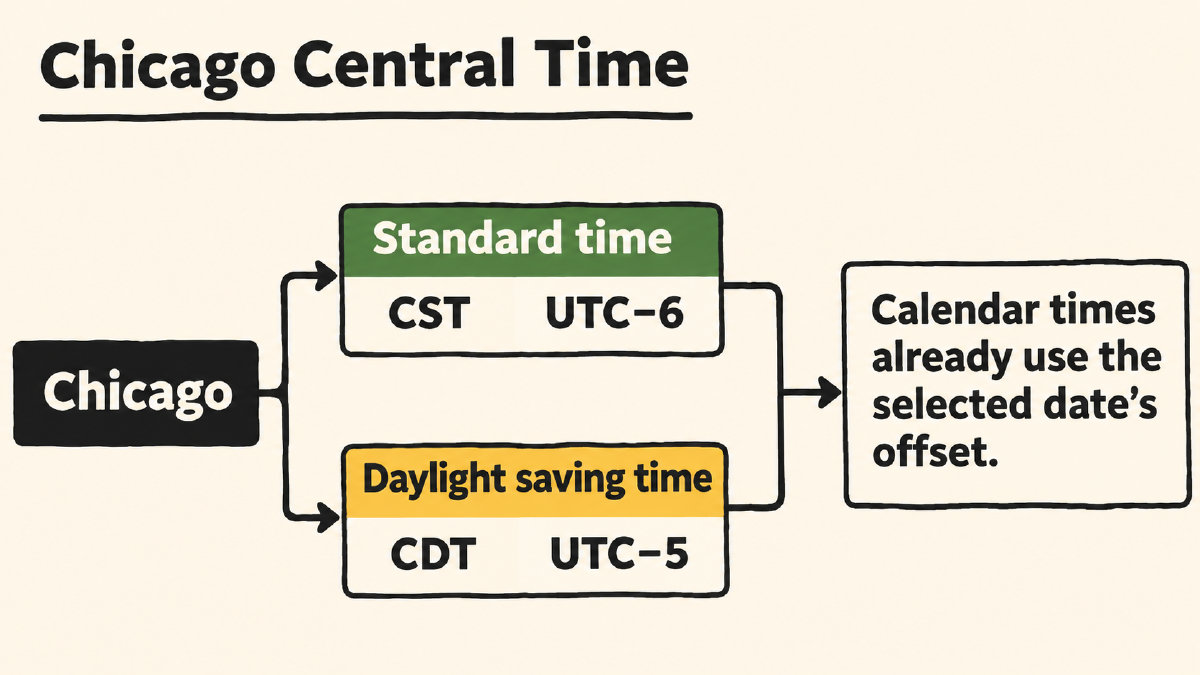
Central Standard Time: UTC−6
Central Daylight Time: UTC−5
Central Time: Includes both Central Standard and Central Daylight times.
In Chicago’s case, though, it observes Central Standard Time during the standard-time months and Central Daylight Time during daylight saving time. During the spring transition, it changes from Central Standard Time (CST) to Central Daylight Time (CDT); during the autumn transition, it goes back again. (Note that this applies to all parts of the United States, with some exceptions.)
Reading the selected Chicago date
You can interpret the selected Chicago date through its printed offset. There are essentially two ways to view a local calendar: through a traditional, fixed table of dates and an automatically adjusted version that takes into account the local time zone. A device’s date picker provides an option that retains the selected date, as well as the address you entered. In either case, there’s a connection between the displayed clocks and calendars, and how they respond to your chosen date.
When you select a date, the calendar shows that date in Chicago, according to the rules for Central Time, whether it be CST or CDT. The document shows that November 9, 2026 will display as “2026-11-09 · America/Chicago ( GMT-6 )”, which is the name of the time zone followed by its applicable UTC offset for that day. This means that when the sun rises over Chicago, it’ll rise at 6:34 AM local time, and set at 4:37 PM. Note that the daylight saving adjustment is already included in the offset: no additional hour needs to be added. And the times are calculated for a point near the city center; your observed sunrise and sunset may differ because of your precise position, horizon, elevation and atmospheric conditions.
Chicago’s exact 2026 clock changes
Chicago follows these rules for moving the hands forward and backward every year:
Every year since 2007, we move our clocks ahead by an hour on the second Sunday of March. On March 8, 2026, 2 a.m. becomes 3 a.m., local time. Spring transition: We skip an hour, meaning that there’s one fewer hour in the civil day.
On the first Sunday of November, the clocks go back an hour — on November 1, 2026, 2 a.m. becomes 1 a.m., local time. Autumn transition: We repeat an hour, meaning that there’s one extra hour in the civil day.
It should come as no surprise that the apparent jump between sunrise and sunset times on either side of a clock change can be misleading. But it’s important to understand that these changed civil-clock labels don’t represent actual elapsed daylight; they’re just changed names for the same event.
So if you want to read a month spanning a transition, say the calendar months of March and November 2026, then look carefully at the dates that fall on either side of the clock shift. If you choose the spring transition (March), you’ll see the dates before and after the time shift. That shift pushes the clocks forward by one hour, moving an hour of daylight from the morning to the evening by the clock. Conversely, when we shift back in the autumn, we move an hour of daylight from the evening to the morning. Neither change adds or removes an hour of actual daylight.
But solar events do change gradually, even when their displayed clock times seem to shift dramatically. From one day to the next, sunrise and sunset change gradually in solar terms, even when a clock change shifts their displayed times by an hour. So, while the clock adjustments might seem to create or remove an hour of sunlight, they actually only reflect a simple label change, with the real events happening in real time. As shown here, the actual times of sunrise and sunset don’t shift dramatically.
Comparing standard time and adjusted calendars
The US Naval Observatory maintains an annual table of sunrise and sunset times, fixed on standard time, which I’m assuming applies to the Chicago area unless otherwise noted. You can also use a free tool like the one found on my website. Both show the time and day of the year, expressed using the 24-hour clock format. For instance, a documented entry reads “1836 = 6:36 p.m.” — the former refers to a military-style designation used on the USNO table, which I’ve converted into a more user-friendly style.
If you’re comparing tables and trying to understand what times mean, consider the need for a manual adjustment. Some calendars automatically adjust for local time, such as the Chicago calendar, in which the applicable CST or CDT is already applied by date. Other calendars fixate on the standard time, in which case you must apply any necessary adjustment manually.
For a USNO annual table set to Chicago’s standard time, add an hour only for dates during daylight saving time. The Chicago calendar already makes that adjustment; its 24-hour display needs no extra hour. (I’ve made the assumption that these times apply to Chicago unless specified otherwise.)
Sources
Check sunrise and sunset times
Choose a city and date for local times and a monthly calendar.
More in Sunrise & Sunset Guides
- Daylight Saving Time Definition for Sunrise and Sunset TimesA daylight saving time definition for sunrise and sunset readers: understand the one-hour clock shift and why it does not add daylight.
- What Is Dusk? How It Differs from Sunset and TwilightWhat is dusk? Learn how everyday dusk differs from sunset and how civil, nautical and astronomical dusk mark the ends of evening twilight phases.
- Longest Day This Year: What June 21, 2026 Means for Your CityThe longest day this year was June 21, 2026. Learn why daylight varies by city and why the latest sunset can fall later.