What Is Dusk? How It Differs from Sunset and Twilight
What is dusk? Learn how everyday dusk differs from sunset and how civil, nautical and astronomical dusk mark the ends of evening twilight phases.
- Twilight
- Sunset Calendars
On this page
You're probably familiar with the term "dusk," but if you ask when dusk is, it's possible that you need to be more specific about what you're asking. After all, a simple answer like “it’s when the sun sets” may not do.
Instead, this article describes what dusk really means. And yes, there are three types of dusk: civil, nautical and astronomical. You’ll learn why dusk differs from sunset and twilight, too.
Dusk and sunset
Sunset is the moment when the Sun dips below the horizon, marking the end of daylight. The conventional definition uses the Sun’s upper edge at the horizon, assuming average atmospheric conditions and a level region. But dusk refers to the illuminated period of time immediately following sunset. In everyday usage, people will refer to “the dusk” as the transition from day to night, which runs from sunset until nighttime. The precise timing of the end of this transition — referred to as dusk in its own right — has been given three names: civil dusk, nautical dusk and astronomical dusk. They’re each defined by how far the Sun’s center falls below the horizon: 6, 12 and 18 degrees, respectively.
So, while the average person may refer to dusk simply as evening, the official definitions of dusk have been given to mark the end of each type of twilight period that occurs after sunset.
Twilight
To understand dusk, we first need to understand what twilight is. As it turns out, twilight is the illumination from scattered sunlight after sunset and before sunrise. Twilight is divided into three phases: civil, nautical and astronomical. Each defines the end of a specific phase of twilight.
The key point here is that twilight isn’t a single event; it’s an entire time span between two events. Civil twilight occurs just after sunset until the Sun is 6 degrees below the horizon, at which point the sunlight that reaches the surface of Earth becomes too weak to allow for reading without artificial lighting. Nautical twilight begins as the Sun’s center drops to 6 degrees below the horizon and ends at 12 degrees, with more stars becoming visible as the sky darkens. Astronomical twilight begins as the Sun’s center drops to 12 degrees below the horizon and ends at 18 degrees, as the fading sunlight makes fainter stars easier to see.
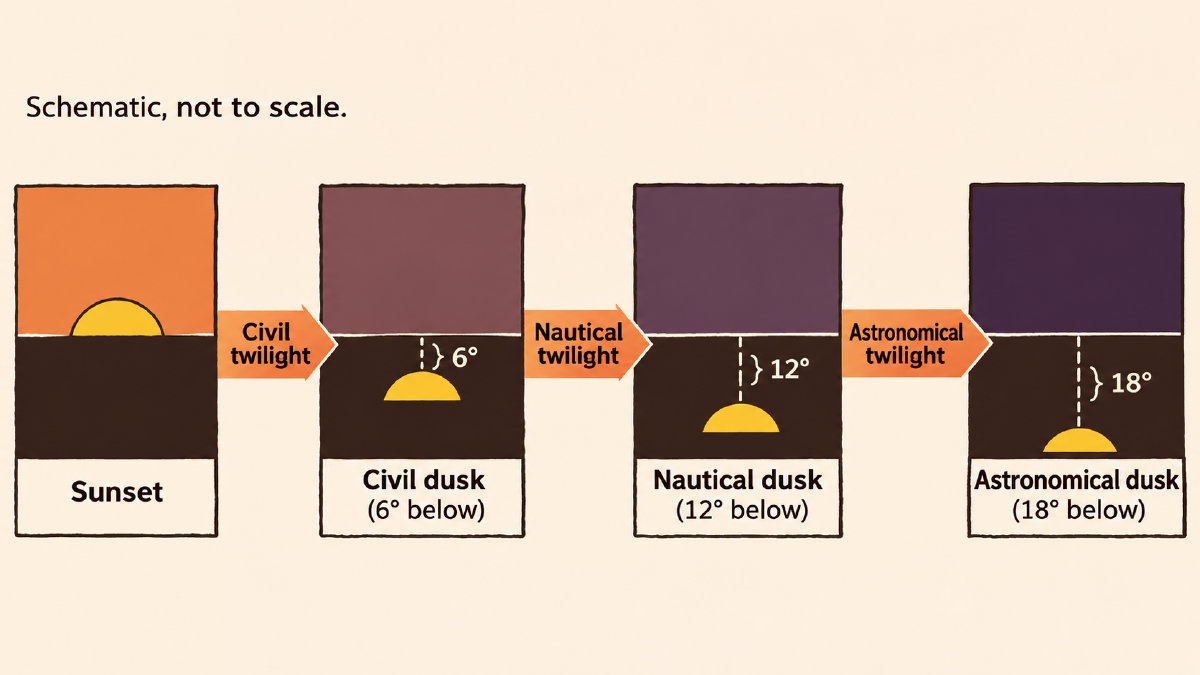
The exact moment of the Sun’s center dropping to these thresholds marks the end of each phase of twilight. That is the definition of each form of dusk.
When is dusk?
Dusk itself, then, occurs in three forms. We’ll cover them all:
Civil dusk
Nautical dusk
Astronomical dusk
Each form of dusk is marked by the point when the Sun’s center drops to a specific degree below the horizon. These values correspond to the end of their respective periods of twilight.
Civil dusk is the moment when the Sun drops to 6 degrees below the horizon, marking the end of civil twilight. At this point, artificial lighting is generally needed to read outside.
Nautical dusk marks the end of nautical twilight. Here, the Sun is 12 degrees below the horizon. The sky still glows faintly, but most stars and constellations are now visible to the naked eye in clear conditions. This threshold defines nautical dusk.
Astronomical dusk is the point when the Sun is 18 degrees below the horizon. At this point, most of the sky should be dark enough to see stars.
But remember, even at astronomical dusk, the skies aren’t completely dark. There are always some natural nighttime light sources, such as the Moon or airglow, as well as man-made light. Plus, atmospheric conditions can change things. What appears dark to one observer might look quite different to another.
Why dusk ends where it does
There’s an important distinction to be made between dusk and sunset. While sunset marks the precise moment when the Sun disappears below the horizon, the precise timing of dusk is defined by how low the Sun falls into the sky. When the Sun finally drops behind the horizon, that’s the conventional ending point of the daylight hours. But once it disappears, the sky remains lit up by the scattered sunlight bouncing around in Earth’s atmosphere. Eventually, however, that scattered sunlight becomes weaker than starlight and other natural light sources, though the sky won’t necessarily look completely black.
That darkness is defined by where the Sun ends up in relation to Earth, which is exactly how dusk is defined.
How to use this information
You can use the site’s sun-time lookup to check sunrise, sunset and the monthly calendar for six supported cities. The separate frozen reference compares the time from sunset to each named twilight endpoint for 2026. The interval depends on latitude and date, so you can’t use a fixed wait after sunset across cities or seasons. This reference doesn’t add live twilight or weather forecasts to the lookup. From there, you can choose the named endpoint that best matches your particular question.
If you’d like to read more, you can follow the separate elapsed-time reference, which contains both the limits described above and a frozen-in-time version of the data.
Sources
Check sunrise and sunset times
Choose a city and date for local times and a monthly calendar.
More in Sunrise & Sunset Guides
- Daylight Saving Time Definition for Sunrise and Sunset TimesA daylight saving time definition for sunrise and sunset readers: understand the one-hour clock shift and why it does not add daylight.
- Longest Day This Year: What June 21, 2026 Means for Your CityThe longest day this year was June 21, 2026. Learn why daylight varies by city and why the latest sunset can fall later.
- Is EDT Standard Time? Reading New York’s Sun CalendarIs EDT standard time? Learn how EDT and EST differ and how to read the date-specific offsets in New York’s sunrise and sunset calendar.