When Is Fall Backwards 2025? Looking Back at November 2
When is fall backwards 2025? Clocks fell back November 2. Learn what the repeated hour meant for sunrise and sunset clock times.
- Daylight Saving Time
- Sunrise and Sunset Calendars
On this page
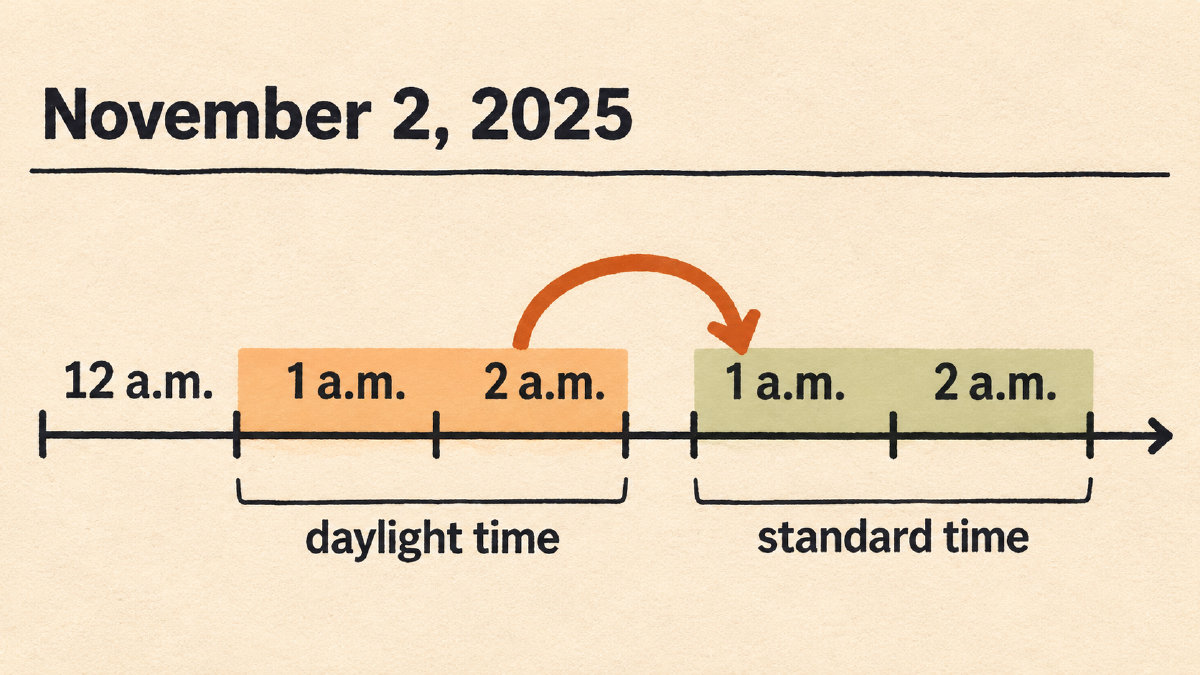
Fall backwards is scheduled for Sunday, November 2, 2025. In 2024, we observed the rollback of our local clocks on November 3; in 2025, that’s on November 2, 2025. That day will end daylight saving time (DST) by moving our clocks one hour back to standard time. Looking back, clocks moved from 2 a.m. local daylight time to 1 a.m. standard time on Sunday, November 2, 2025.
The repeated hour
One question about fall backwards concerns how it extends the local civil day. This occurs because when DST ends, the hour between 1 a.m. and 2 a.m. occurs twice: once before the hour is “rolled back” and once after the return to standard time. The extra hour doesn’t add any sunlight, though.
Shared transition rules across six cities
November 2, 2025, is the common date on which all six cities observe the clock change — San Diego; San Francisco; New York; Chicago; Las Vegas; and Portland, Oregon. While each city shares the same local-time transition rule, the clock changes don’t all occur simultaneously. Instead, each observes the shared transition rule on their own local times. For example, San Diego rolls its clock back from Pacific Daylight Time (PDT) to Pacific Standard Time (PST) at 2 a.m. local daylight time, while New York City does so at 2 a.m. local daylight time in Eastern Time (EDT). All six cities share the transition at 2 a.m. local daylight time. So yes, the shared transition rule answers the question “when is fall backwards 2025?”
But the instant at which you roll your clocks back is not necessarily the same nationwide. Rather, you might think of it as a common date — but with no simultaneous occurrence. You can read more about what exactly causes sunrise and sunset to appear earlier when DST ends below.
Sunrise and sunset appearing earlier
Why do sunrise and sunset seem to occur earlier on the clock than on consecutive days? It’s due to the relabeling of the duration of daylight rather than an actual loss of daylight. When we roll our clocks back an hour, we shift the distribution of the available daylight to favor the morning over the evening. But we also are comparing a date that includes the “extra” hour with another that does not. That means that the readings aren’t necessarily precisely one hour apart. As such, if you look at sunrise and sunset times on November 1, 2025, compared to those on November 2, 2025, you’ll see an apparent jump.
Interpreting calendars across the transition
To clarify the calendar entries for the entire week, let’s examine how the calendar will look both before and after the change:
• November 1, 2025: This is before the rollback occurs.
• November 2, 2025: After the rollback, this is when the sun rises and sets at these times. On the clock, sunrise and sunset will appear to happen earlier than on the prior day, but it’s not because of any loss of daylight. Rather, the clock time has been adjusted back an hour, shifting daylight earlier on the clock. What appears to be a “jump” is actually caused by changing the time convention itself, not because one hour of daylight disappears.
Sources
Check sunrise and sunset times
Choose a city and date for local times and a monthly calendar.
More in Sunrise & Sunset Guides
- Daylight Saving Time Definition for Sunrise and Sunset TimesA daylight saving time definition for sunrise and sunset readers: understand the one-hour clock shift and why it does not add daylight.
- What Is Dusk? How It Differs from Sunset and TwilightWhat is dusk? Learn how everyday dusk differs from sunset and how civil, nautical and astronomical dusk mark the ends of evening twilight phases.
- Longest Day This Year: What June 21, 2026 Means for Your CityThe longest day this year was June 21, 2026. Learn why daylight varies by city and why the latest sunset can fall later.