When Is Magic Hour? Plan Around Local Sunrise and Sunset
Learn when magic hour occurs, how golden and blue hour differ, and how to plan using local sunrise, sunset and date calendars.
- Golden Hour
- Sunrise and Sunset Planning
On this page
Photographers use the term “magic hour” to refer to a time of day that produces particularly beautiful light. The definition depends on how the photographer defines golden hour, which is the time shortly after sunrise or before sunset when the sun is at a low angle, producing warm, reddish tones. Some photographers might instead use magic hour as an alternative name for the cinematographic period right after sunset until nightfall.
There are multiple competing definitions of what golden hour and magic hour actually mean. This article attempts to explain these differences and describe how you can plan your own photo shoots around golden hour and blue hour. We’ll also cover twilight, with its broad transition between daylight and night.
Golden hour blue hour and twilight
What’s the difference between golden hour and blue hour?
Golden hour refers to a brief period shortly after sunrise or before sunset when the sun is at a low angle in the sky, casting soft, red light on everything it touches. In comparison, blue hour describes the time just before morning golden hour or after evening golden hour when there is no direct sunlight but residual sunlight casts a predominantly blue hue over the landscape.
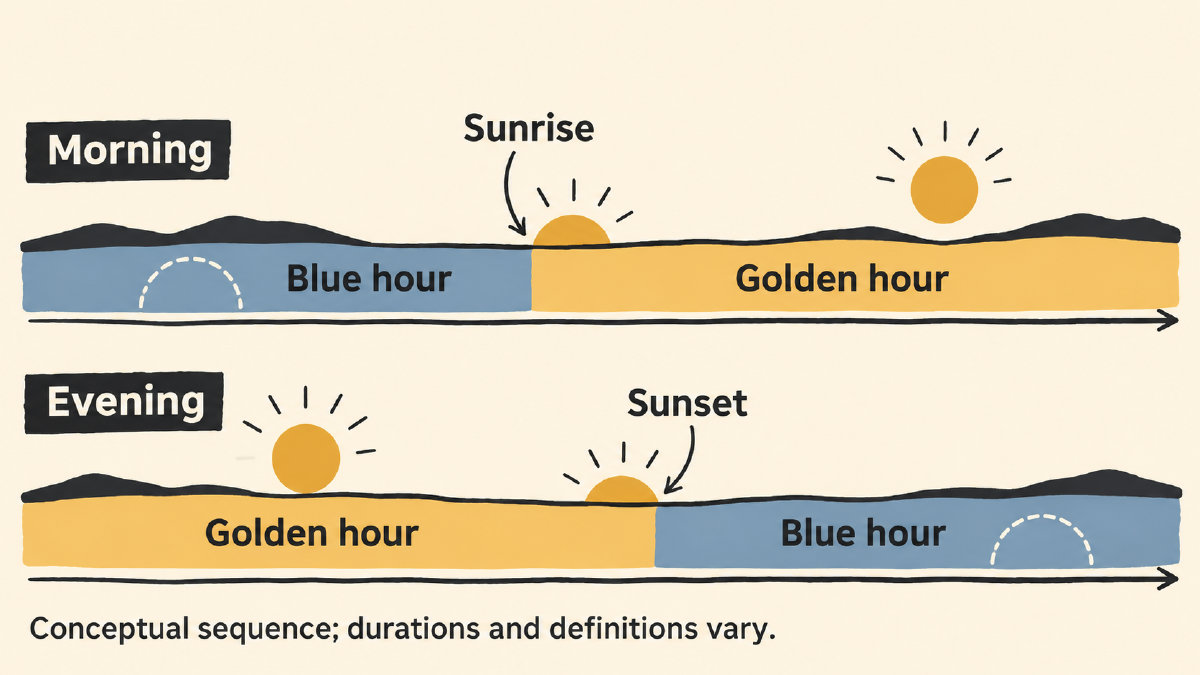
Twilight is the broader transition toward nightfall; sunset marks one point within that transition. There are different ways to define twilight, depending on how much ambient light remains: civil, nautical, and astronomical dusk, respectively.
Some calculators offer both golden-hour and blue-hour windows. The duration will vary by season, latitude, and chosen definition, so you shouldn’t expect any precise intervals. If we define golden hour as 1 hour before sunset or after sunrise, then that would be insufficient for exact boundaries. (We’ll explore this further later.)
Planning around local sunrise and sunset
Why do figurative hours vary and calculator windows disagree?
The golden hour varies in length depending on the season, location, and solar-elevation convention that a calculator applies. I recommend sticking to your supported city’s selected-date sunrise or sunset, and comparing candidate dates within your monthly calendar:
Sunrise/Sunset
Sunset Today
San Diego
San Francisco
New York
Chicago
Las Vegas
Portland, Oregon
Select a date that matches the intended local calendar date. Golden hour is usually thought of as shortly after sunrise or before sunset. However, some cinematographers use magic hour for the period after sunset before nightfall.
Sunrise Today
San Diego
San Francisco
New York
Chicago
Las Vegas
Portland, Oregon
Again, compare candidate dates within the month. For instance, if you want to capture golden-hour light for an event in Las Vegas, you might need to consider whether the golden-hour window will fall during daylight saving time or not. It could also help to look at the light observed at an exact spot: terrain, buildings, atmospheric conditions, and even elevation can all affect what’s visible at that moment.
Using calendars to compare dates
How do calendars support planning?
Sunset Today uses SunCalc to calculate sunrise and sunset. When you select a city, it provides a table of times based on the selected city-center latitude and longitude. That information should be correct assuming that your device supports the selected city’s IANA time zone. It factors in daylight saving changes and accounts for differing offsets across clock changes. Each calendar date must be calculated separately.
The event times are rounded to the nearest whole minute. What you observe, however, might be slightly off, either because of the calculation’s offset or simply because of a differing number of minutes. How long is the day? The elapsed interval between calculated sunrise and sunset tells you that.
You can print out the month table and begin to see how the amount of daylight changes throughout the year, as well as how each date compares to another. Again, it’s important to note that this table offers only a date-by-date comparison, not a second-by-second record of the day’s lighting.
While a downloadable file can give you details about what time the sun rises and sets, what you observe at a given spot will depend on elevation, terrain, nearby buildings, and atmospheric conditions, among other factors. So while these calendars provide planning support, they cannot guarantee that you’ll see exactly the lighting conditions you’re expecting.
Sources
Check sunrise and sunset times
Choose a city and date for local times and a monthly calendar.
More in Sunrise & Sunset Guides
- Daylight Saving Time Definition for Sunrise and Sunset TimesA daylight saving time definition for sunrise and sunset readers: understand the one-hour clock shift and why it does not add daylight.
- What Is Dusk? How It Differs from Sunset and TwilightWhat is dusk? Learn how everyday dusk differs from sunset and how civil, nautical and astronomical dusk mark the ends of evening twilight phases.
- Longest Day This Year: What June 21, 2026 Means for Your CityThe longest day this year was June 21, 2026. Learn why daylight varies by city and why the latest sunset can fall later.