Comparing Central Standard Time and Eastern Standard Time for Sunsets
Compare Central Standard Time and Eastern Standard Time, use seasonal labels correctly, and put Chicago and New York sunsets on the same time basis.
- Time Zones
- Daylight Saving Time
On this page
The names “Central Time” (CT) and “Eastern Time” (ET) are used year-round, while standard-time labels refer only to the non-daylight period. Chicago uses “Central Standard Time” (CST) during the non-daylight period, while it uses “Central Daylight Time” (CDT) during daylight time. In New York, meanwhile, it uses “Eastern Standard Time” (EST) during the non-daylight period; it switches to “Eastern Daylight Time” (EDT) during daylight saving.
Central Standard Time and Eastern Standard Time Offsets
In terms of UTC offsets, Chicago is at CST: UTC−6, but shifts to CDT: UTC−5. New York is at EST: UTC−5, shifting to EDT: UTC−4. To convert CST to EST, add one hour; in reverse, subtract one. So 23:30 CST becomes 00:30 EST the next day. While both cities use the same name (“CT” and “ET”) for their local times across the seasons, there’s a subtle difference in how they switch between standard and daylight time. In particular, Chicago shifts from CST to CDT at 2 a.m. on March 8, 2026, while New York switches from EST to EDT at 2 a.m. on March 8, 2026. Likewise, both cities shift back to their respective standard times at 2 a.m. on November 1, 2026.
The one-hour difference between New York and Chicago is preserved if you match up their respective seasonal offsets. But since these transitions occur at different instants, you’ll need to check what the offset is in each city when you’re comparing them. The clock changes take place at 2 a.m. local time in each city, though for daylight saving, New York clocks jump forward by an hour at 2 a.m. local time on March 8, 2026, making it 3 a.m.; in fall on November 1, 2026, clocks move back from 2 a.m. to 1 a.m. For now, however, we can safely assume that the differences in time are consistent with what’s documented above.
Using City Calendars to Compare Sunsets
A documented calendar workflow makes it easy to compare sunsets. All you need to do is select the date of interest on both city pages, and then look through the monthly table for that month to find the matching sunset or sunrise time. Use the city’s date; your selection stays in the address bar. Each row already uses its date’s seasonal offset, so no daylight-saving adjustment is needed.
The October 31, 2026 date has been selected on the calendars of both cities, so let’s take a look at those two locations and their respective time zones:
Chicago
New York
Comparing Sunset Events in the Same Time Zone
In Chicago, it’s CDT: UTC−5 on October 31, 2026, and the sunset is predicted to occur at 17:48 CDT. We’ll apply the +5 hour correction to get 22:48 UTC. However, that isn’t necessary in this case, because we know what the New York local reading will be — 18:48 EDT. New York’s own sunset is at 17:55 EDT, which is a separate event, 53 minutes earlier.
But here’s where things become complicated: If I convert my Chicago sunset event into New York time, I get 18:48 EDT; if I convert my New York sunset event to Chicago time, I get 16:55 CDT. Comparing both events in either city’s time puts New York’s sunset 53 minutes earlier. Each location’s city-center prediction is rounded to the nearest minute, and your visibility may vary depending on your own local horizon and weather, but neither changes the time-zone conversion.
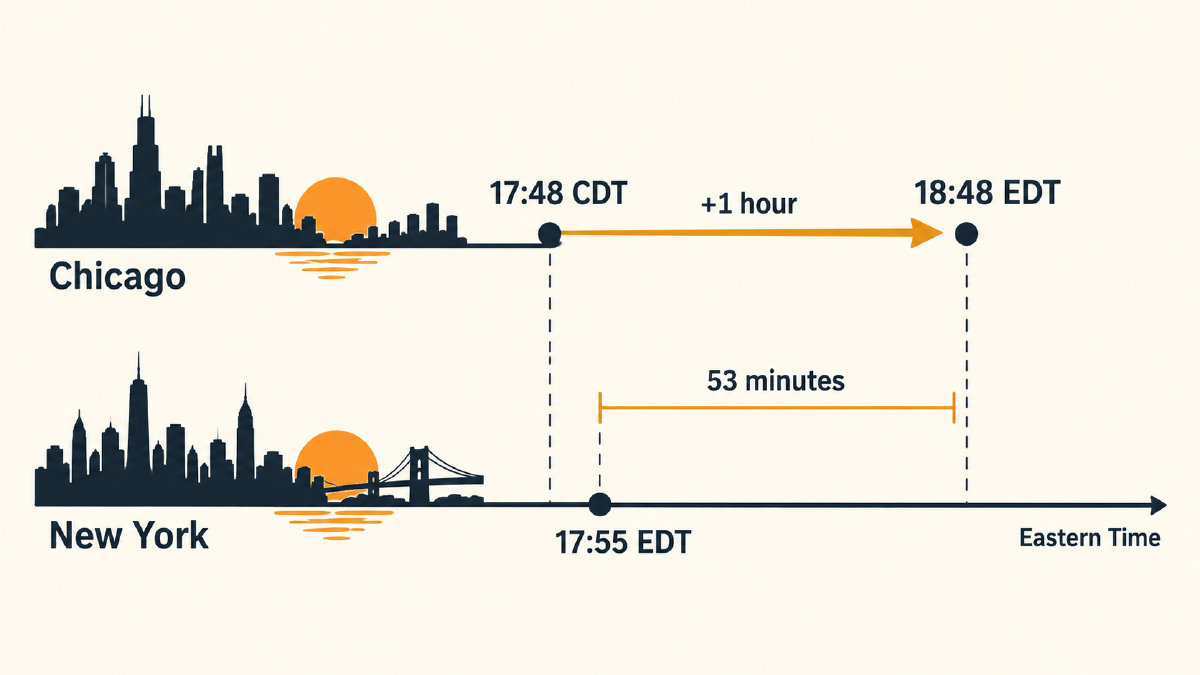
What matters for the conversion is using each city’s offset on the selected date: UTC−5 for Chicago and UTC−4 for New York. This means we need to put both events into the same time zone, or UTC, before comparing them; changing the time zone used to display them won’t change the elapsed time between them. Clock changes can shift displayed sunrise and sunset times while solar events change gradually. Daylight duration measures elapsed time between that date’s sunrise and sunset, without an automatic one-hour gain or loss.
Sources
Check sunrise and sunset times
Choose a city and date for local times and a monthly calendar.
More in Sunrise & Sunset Guides
- Do We Gain or Lose an Hour on November 1, 2026?Do we gain or lose an hour on November 1, 2026? Gain one: clocks fall back at 2 a.m. local time, shifting sunrise and sunset clock readings.
- Pacific Time to Eastern Standard Time for Sunrise and SunsetConvert Pacific Time to Eastern Standard Time for sunrise and sunset: when to add two or three hours, and how New York time differs.
- Las Vegas Time Zone: How DST Changes Sunrise and Sunset Clock TimesSee how PST, PDT and the 2026 daylight saving transitions affect the sunrise and sunset clock times shown for Las Vegas.