When Did Daylight Saving 2026 Change Clocks in These Six Cities?
Daylight saving 2026 ran March 8–November 1. See what the clock changes meant for sunrise and sunset in six supported U.S. cities.
- Daylight Saving Time
On this page
The shared 2026 daylight saving dates for these six cities will be the same, and the autumn transition will have already occurred on November 2. All six cities will resume standard time.
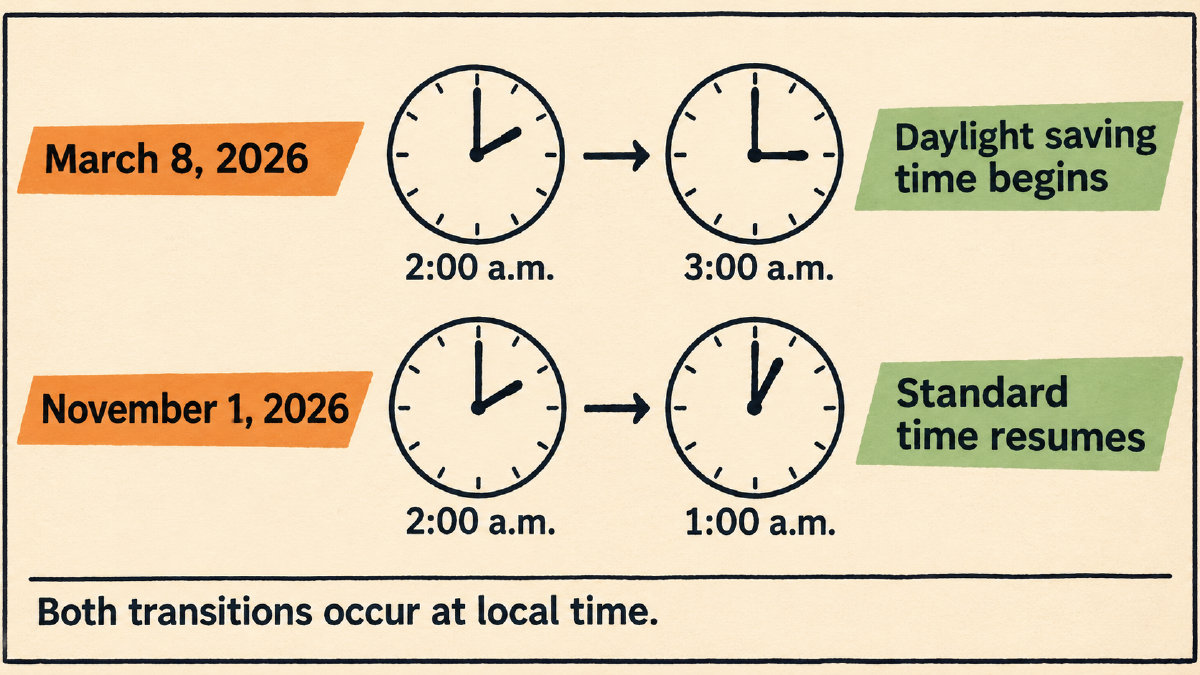
Daylight saving 2026 transition dates
March 8, 2026: Daylight saving began at 2 a.m. local time
November 1, 2026: Daylight saving ended at 2 a.m. local time
November 2, 2026: Autumn transition already completed; standard time resumed
The spring jump skipped an hour — March 8: 2 a.m. to 3 a.m., clocks advanced one hour, skipping the hour of 2 a.m. The autumn reversal repeated an hour: November 1: 2 a.m. to 1 a.m., clocks moved back one hour, repeating the hour of 1 a.m. Each transition was governed by the local clock, not a single nationwide instant.
How sunrise and sunset clock labels change
The change in sunrise and sunset clock labels is distinct from the elapsed daylight between them. The spring clock adjustment moves both sunrise and sunset one hour later by the clock; the autumn adjustment moves both one hour earlier. In spring, you’ll see that the daylight shifted toward the evening, which is what the “spring adjustment” does. Conversely, during the autumnal transition, you’ll see that the daylight shifts toward the morning, hence the “autumn” adjustment.
But what happens with the actual clock time? Let’s think of San Diego as an example. At the spring adjustment, the clock jumps from 2 a.m. to 3 a.m., skipping the 2 a.m. hour. That doesn’t mean that the sun had already risen. The adjustment moves sunrise and sunset one hour later by the clock, apart from ordinary daily change. During the autumnal transition, however, the clock moves from 2 a.m. back to 1 a.m., so sunrise and sunset move one hour earlier by the clock, again apart from ordinary daily change. But since each day passes at the same speed, there is no corresponding hour of daylight removed or added.
In this example, you can compare adjacent entries of San Diego’s autumn sunrise and sunset calendars to find out how much they changed compared to the previous day. You must separate the clock adjustment from ordinary daily change and apply the local-time adjustment only once. For instance, if you compare October 31, 2026 — a daylight-time date — with November 1, 2026 — sunrise and sunset after the overnight return to standard time — the difference includes both the one-hour clock adjustment and ordinary daily change, so it need not be exactly one hour. But if you’re looking at the same city, then adjacent dates would allow for comparing the sunrise to the sunrise of the previous day and vice versa.
The six cities
So, here are your options:
San Diego
San Francisco
New York
Chicago
Las Vegas
Portland, Oregon
Sources
Check sunrise and sunset times
Choose a city and date for local times and a monthly calendar.
More in Sunrise & Sunset Guides
- Comparing Central Standard Time and Eastern Standard Time for SunsetsCompare Central Standard Time and Eastern Standard Time, use seasonal labels correctly, and put Chicago and New York sunsets on the same time basis.
- Do We Gain or Lose an Hour on November 1, 2026?Do we gain or lose an hour on November 1, 2026? Gain one: clocks fall back at 2 a.m. local time, shifting sunrise and sunset clock readings.
- Pacific Time to Eastern Standard Time for Sunrise and SunsetConvert Pacific Time to Eastern Standard Time for sunrise and sunset: when to add two or three hours, and how New York time differs.