When Was the Shortest Day of the Year 2025 in Six U.S. Cities?
The shortest day of the year 2025 was December 21. Understand the solstice and find documented steps for checking historical sunrise and sunset.
- Winter Solstice
- Daylight Length
On this page
The shortest day of the year 2025 brings to the Northern Hemisphere falls around the December solstice, on December 21 or 22. The solstice happens at one instant worldwide; your latitude affects how much daylight you get.
In this article I’ll tell you when the shortest day of the year was in six U.S. cities: San Diego, San Francisco, New York, Chicago, Las Vegas, and Portland, Oregon.
Historical shortest-day date
The historical shortest-day date for all six cities is the same: December 21, 2025 at 15:03 UT (i.e., 3:03 p.m. UTC). This is the Northern Hemisphere winter solstice — the moment when the Earth’s axis is tilted farthest from the Sun, which causes the shortest day of the year.
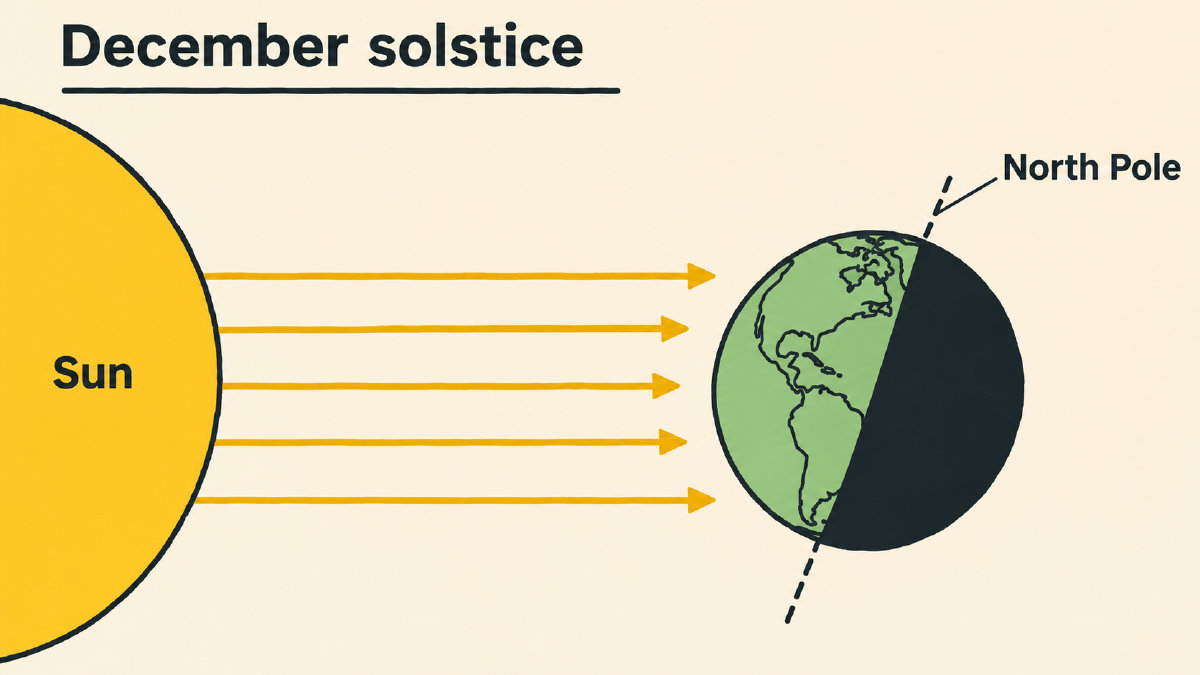
This is an astronomical moment, not a calendar date. The solstice occurs at a single instant each year, but the daylight period that includes it will fall on a specific calendar date depending on where you live. In some places, the earliest sunset and latest sunrise may fall on different dates than the solstice, as we’ll see below.
Shortest day as minimum daylight
A “shortest day” is usually interpreted as the day with the least amount of daylight. That means the shortest day is the day with the smallest total amount of daylight, i.e., the longest night.
This is a seasonal pattern, caused by the tilt of the Earth’s axis. At any given time of year, the location of the Sun directly overhead moves around the globe. During the winter solstice, that location is farthest away from the Northern Hemisphere, so that region experiences shorter days and longer nights. And the higher up you are in the northern latitudes, the shorter the winter days get.
So the shortest day of the year is the one with the least amount of daylight. But there’s another way to interpret the term “shortest day”: as the day when the sun rises latest or sets earliest. Those two events can happen on different days than the solstice, because the timing of sunrise and sunset varies throughout the year. The earliest sunset and latest sunrise depend on your latitude, and the variation in the solar day (which is what determines clock times) also changes throughout the year due to the elliptical shape of the Earth’s orbit.
Distinguishing between these concepts is important, because they’re often conflated. The earliest sunset and the latest sunrise are both separate clock-time extremes, and neither individually identifies the shortest day. They’re only related to the shortest day in that they both occur near it. But their exact timing relative to the solstice depends on the latitude.
The solstice is the turn toward lengthening daylight
Another common confusion is between the increase in total daylight and whether sunrise has begun moving earlier. If the sun is setting later, the total amount of daylight can still be decreasing if sunrise is moving later faster. And if the sun is rising later, daylight can still be increasing if sunset is moving later faster. So while the earliest sunset and the latest sunrise are both associated with the shortest day, they don’t necessarily correspond to the same point in time. The solstice itself marks the start of lengthening daylight.
So the shortest day of the year is the day when the total amount of daylight is minimized. What matters is the interval between sunrise and sunset, not whether either was at its clock-time extreme.
Walk through a historical lookup
To find out when the shortest day of the year was in each city, I looked up the annual tables of sunrise and sunset times from the USNO. Here’s how I did it:
On the USNO annual-table form, I entered 2025, selected the table type (“sunrise/sunset”), and specified the city’s location and standard time zone. Finally, I clicked the “Get Data” button to compute the table, repeating this for each city.
The resulting table lists sunrise and sunset times for each day of the year. To find the shortest day of the year, I needed to look for the row in the table where the total daylight duration was minimized. I could do this by subtracting the sunrise time from the sunset time for each day, and looking for the day with the smallest difference.
I couldn’t use the earliest sunset or latest sunrise as a shortcut, since those clock-time extremes fall on different dates from the shortest day.
I found that the shortest day of the year in each city was on December 21, 2025. This is the same for all six cities, which makes sense because they’re all located in the Northern Hemisphere.
The exact time of the solstice was the same for all six cities: December 21, 2025 at 15:03 UT. This is because the solstice is a single astronomical moment, regardless of the latitude of the observer.
In conclusion, the shortest day of the year in six U.S. cities was on December 21, 2025. This is the same for all six cities, which makes sense because they’re all located in the Northern Hemisphere. The exact time of the solstice was the same for all six cities: 15:03 UT.
Sources
Check sunrise and sunset times
Choose a city and date for local times and a monthly calendar.
More in Sunrise & Sunset Guides
- When Did Daylight Saving 2026 Change Clocks in These Six Cities?Daylight saving 2026 ran March 8–November 1. See what the clock changes meant for sunrise and sunset in six supported U.S. cities.
- Comparing Central Standard Time and Eastern Standard Time for SunsetsCompare Central Standard Time and Eastern Standard Time, use seasonal labels correctly, and put Chicago and New York sunsets on the same time basis.
- Do We Gain or Lose an Hour on November 1, 2026?Do we gain or lose an hour on November 1, 2026? Gain one: clocks fall back at 2 a.m. local time, shifting sunrise and sunset clock readings.