Is Your Sunset Calendar’s Timezone Pacific Standard Time or PDT?
Understand the Pacific Standard Time timezone, UTC−8, and when PDT, UTC−7, applies to dates in the four supported Pacific cities.
- Pacific Time
- Daylight Saving Time
On this page
A sunrise or sunset calendar may be a helpful resource, particularly for planning an outdoor event. However, interpreting the time and date of such events is important: some calendars may refer to a specific timezone as “PST” (Pacific Standard Time) whereas others might use “PDT” (Pacific Daylight Time). But what’s the difference?
PST and Seasonal Pacific Time
The distinction between fixed standard time and seasonal Pacific Time when interpreting a dated sunrise or sunset entry is significant.
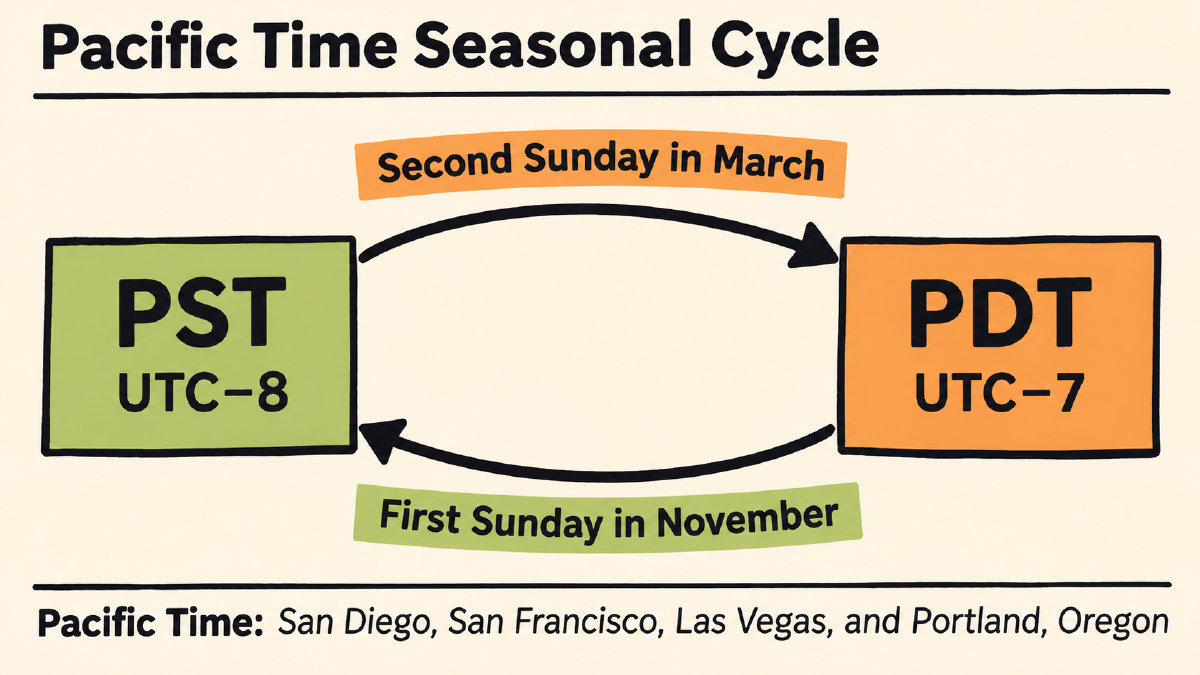
PST is simply Pacific Standard Time; that is, eight hours behind Coordinated Universal Time (UTC) in the UTC−8 offset, and is used during the non-daylight saving season. As such, it is also referred to as “PT”, or Pacific Time, but that can include both PST and PDT.
If you’re not sure whether a particular sunrise or sunset is occurring on a weekday or weekend, you should look to the date of the entry itself. The calendar will apply a seasonal offset to interpret that date.
Daylight Saving Changes in 2026
In general, daylight saving in the United States runs from spring through summer into autumn. In 2026, the United States plans on changing clocks twice: once at 02:00 Sunday, March 8, marking the start of daylight saving, and again at 02:00 Sunday, November 1, which marks the end of daylight saving. Since 2007, the U.S. change from PST to PDT has occurred at 02:00 on the second Sunday in March, with the return to PST at 02:00 on the first Sunday in November.
For example, suppose we were to check the solar times from San Diego, California, which is located within the U.S. state of California, and falls within the Pacific Time Zone. A search reveals a calendar that provides sunrise and sunset times with dates and months selected. This means that the date is selected by the user.
If the user selects March 8, they should read the local sunrise and sunset times from the San Diego calendar for that date and year. If the user instead selects April 1 (a day during daylight saving), then they should check that date’s entry for the actual solar-event times.
This illustrates how the date affects the interpretation of the time. For the purpose of this article, however, I’ll assume that readers have selected March 8 and are looking to determine whether that date falls into PST or PDT. On March 8, 2026, San Diego remains on PST until 02:00, when clocks advance to 03:00 Pacific Daylight Time, or PDT. The sunrise and sunset entries for that date therefore use PDT. In this case, that time corresponds to the UTC−7 offset. On April 1, that would still be PDT, with the same UTC−7 offset.
Selecting the Correct City Calendar
However, the key point to remember is that these calendar pages provide actual solar-event times for each location based upon your selection. So, if you select San Diego, California, then that page is where you’ll want to look. If you’re confused about which city to select, here are a few more examples of solar-event calendars that offer options for different cities:
San Francisco, California
Las Vegas, Nevada
Portland, Oregon
Each of these city pages lists sunrise and sunset times identified as local, with options to select a date and month. The calendars show daylight length information, along with a full-month calendar.
So, if your calendar doesn’t clearly identify the city, then you’ll need to make sure that you’ve made the correct selection. Otherwise, you’ll be reading your sunset calendar in the wrong timezone!
Sources
Check sunrise and sunset times
Choose a city and date for local times and a monthly calendar.
More in Sunrise & Sunset Guides
- When Was the Shortest Day of the Year 2025 in Six U.S. Cities?The shortest day of the year 2025 was December 21. Understand the solstice and find documented steps for checking historical sunrise and sunset.
- When Did Daylight Saving 2026 Change Clocks in These Six Cities?Daylight saving 2026 ran March 8–November 1. See what the clock changes meant for sunrise and sunset in six supported U.S. cities.
- Comparing Central Standard Time and Eastern Standard Time for SunsetsCompare Central Standard Time and Eastern Standard Time, use seasonal labels correctly, and put Chicago and New York sunsets on the same time basis.